As we enter exam season, it is natural for pupils and families to feel that academic work must take priority. Revision timetables become more intense, evenings become busier, and it can be tempting to see physical activity as something to reduce, pause, or return to once exams are over…
…I understand that instinct, but I also strongly argue that it is the wrong one.
In my view, exam season is precisely the time when young people need regular physical activity the most. When pressure increases, we should not be removing one of the most effective ways pupils have to manage stress, clear their minds, sleep better, and return to their work with greater focus.
At Rugby School Japan, we often talk about developing “the whole person”. This is not just a phrase that sounds good in a prospectus, we mean it, and to me It is one of the most important responsibilities we have as a school. Academic success matters, of course it does, but it should not come at the expense of pupils’ physical wellbeing, emotional resilience or long-term health. In fact, they compliment each other.
I fundamentally believe that PE, sport and physical activity are central to academic success. They are not extras. They are not distractions. They are part of how young people learn to look after themselves.
The World Health Organization (WHO) recommends that children and adolescents aged 5 to 17 should average at least 60 minutes of moderate to vigorous physical activity per day, with activities that strengthen muscle and bone included at least three times per week. In Japan, the Ministry of Health, Labour and Welfare also references the Japan Sports Association’s “Active Child 60min.” guidance, which encourages children to engage in physical activity for at least 60 minutes daily through play, daily life, PE and sport.
The picture in Japan is encouraging in some ways, but there is still work to do. The 2022 Japan Report Card on Physical Activity for Children and Youth reported that 63% of Japanese 13 to 15-year-olds accumulated at least 60 minutes of moderate to vigorous physical activity on at least four days per week. That is positive compared with many countries, but it also means that a significant number of young people are not active every day.
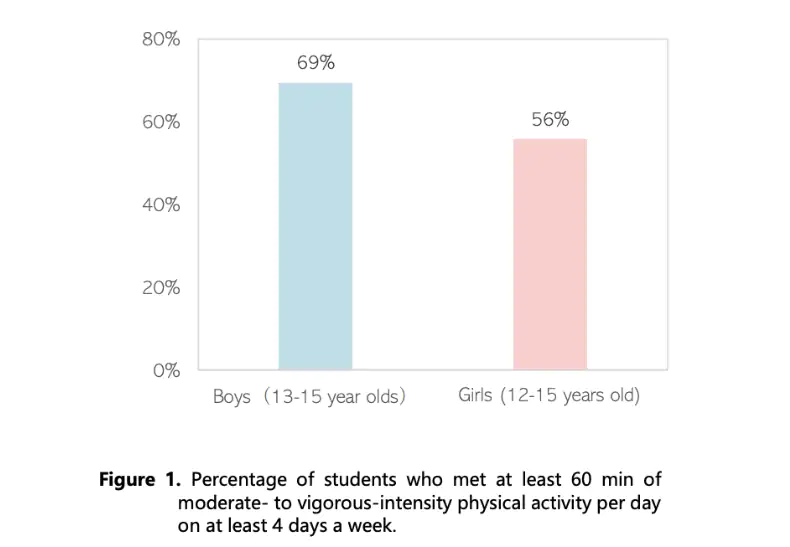
Tanaka, C. et al. (2022). The 2022 Japan Report Card on Physical Activity for Children and Youth: Details of Method and Results. Active Healthy Kids Global Alliance / Japan Report Card. Figure 1, p.7.
Globally, the picture is even more concerning. WHO-led research has found that more than 80% of school-going adolescents do not meet the recommended one hour of daily physical activity. The same research also found that girls are generally less active than boys, with 85% of girls and 78% of boys not meeting the guidelines.
For me, these statistics are not just numbers. They reflect a real challenge that schools, parents and young people are facing. As pupils get older, physical activity can easily drop away. Academic workload increases. Confidence can change. Social pressures become stronger. Pupils become busier, and exercise is often one of the first things to disappear.
That worries me.
It worries me because habits formed during school years often shape habits for life. If young people learn that exercise is something they only do when they have spare time, they may carry that mindset into adulthood. But if they learn that physical activity is part of a balanced, healthy and successful life, then we have given them something far more valuable than a single fixture, grade or performance.
This is why schools have such an important responsibility. We are not just preparing pupils for the next match, the next assessment or the next exam. We are helping them build the habits, values and confidence that will support them long after they leave RSJ.
During exam season, I feel particularly strongly about this. Physical activity should not be seen as a distraction from revision, instead as a support mechanism for it.
Exercise can help young people manage stress, improve mood, sleep better and return to their studies with greater focus. I see this all the time. Pupils may arrive tired, frustrated or mentally overloaded, but after moving, competing, training or simply being active with their friends, they often leave in a better place.
Of course, balance is important. I am not suggesting that a pupil should spend hours training every evening when they have examinations the next morning. However, a short run, a swim, a gym session, a walk, a game of basketball, or even 20 minutes of movement can make a meaningful difference. In general, the best revision breaks are not passive; they are active.
As parents and teachers, I think we have to be careful about the messages we send. If pupils hear that sport and exercise must stop because exams are coming, they may begin to see physical activity as optional, or even as an obstacle to success. I believe we should be sending the opposite message: looking after your body is part of looking after your mind.
At RSJ, our aim is not simply to produce pupils who can perform in a match or complete a fitness test. I want pupils to understand the value of movement. I want them to find forms of physical activity they genuinely enjoy. I want them to see exercise not as a punishment, a chore or something only for the “sporty” pupils, but as something that belongs to everyone.
That, to me, is one of the most important purposes of PE and sport in a school.
So, during this exam season, my message to pupils and parents is simple: KEEP MOVING. Revise hard, prepare well, but do not neglect the very thing that may help you manage the pressure. Physical activity is not a reward for when the work is finished. It is one of the tools that helps you do the work well.
In a school that believes in developing the whole person, physical activity is not an extra. It is essential.
Jordan Nwachukwu
Director of Sport
Head of Physical Education & Sports Science
Rugby School Japan